
PECS FACTS

AAC refers to the ways a person communicates other than or in addition to speaking. AAC can be used by people of all ages and abilities. Alternative communication may be used when a person has not yet started talking, or they have stopped talking for any reason. Augmentative communication may be used when a person’s speech is not always clearly understood or is not complex or specific enough to meet their daily needs. There are many AAC options such as PECS, sign language, picture point systems, and speech-generating devices.
Research has shown that the PECS protocol will not inhibit or impede a person’s speech development. In fact, research has shown that the PECS protocol supports speech development, and the teaching strategies used may help some people speak more!
Pyramid Educational Consultants has trained hundreds of thousands of individuals, including educators, parents, caregivers, and siblings to implement the Picture Exchange Communication System (PECS) across a wide range of settings. Professionals from diverse disciplines, such as occupational therapists (OTs), speech-language pathologists (SLPs), physical therapists (PTs), paraprofessionals, teachers, social workers, and behavior analysts, have successfully used PECS with learners ranging from as young as 18 months to adults in their 80s. Research supports that individuals from varied backgrounds can learn to implement PECS in home, school, and community environments.
Additionally, research and clinical experience consistently emphasize that outcomes with PECS are closely tied to the quality and fidelity of training. High-quality, competency-based instruction is critical to ensuring the protocol is implemented effectively and leads to meaningful communication gains. Pyramid Educational Consultants’ workshops are specifically designed to provide this level of in-depth, structured training, equipping participants with the skills needed to implement PECS with fidelity. While foundational knowledge of the protocol can be gained through resources such as the PECS Manual and Pyramid’s free materials and videos (e.g., on YouTube®), formal training through Pyramid offers a level of rigor and guided practice that is strongly associated with more consistent and successful outcomes.
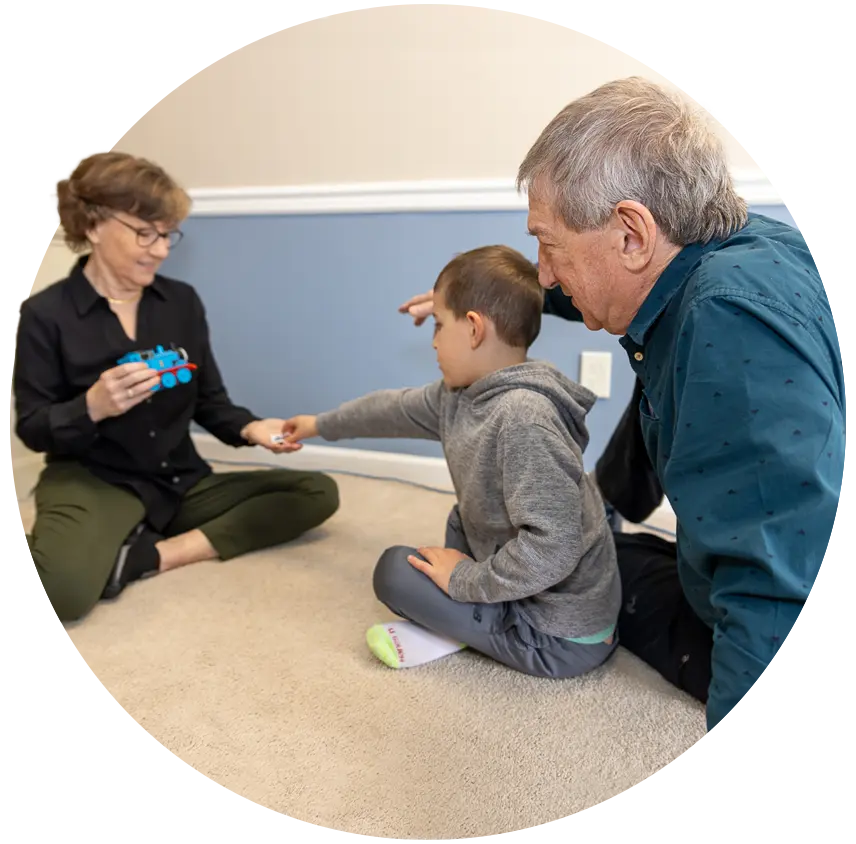
The earliest Phases of the PECS Protocol focus on teaching a learner that communication involves delivering a message to another person. Our focus is on teaching meaningful communication skills immediately, so our early implementation focuses on the learner’s interests. Initiating communication and requesting are the first skills taught in PECS, and the protocol leads to teaching commenting (e.g. I feel, It’s, I don’t like and more!), answering questions and engaging in conversations. We quickly work on teaching our learners self-advocacy skills beginning with indicating “no” and work diligently to honor their choices. PECS is not only about teaching people to ask for things, but to ask for help, to join in activities with others, ask questions, indicate when they don’t want something and other skills significant for them.
When starting PECS, we carefully listen to and observe the people we are teaching to communicate and start with learner led interactions. To teach any skill, we often rely on prompting. Prompts are teaching strategies that help a learner acquire skills, such as communicating, that they do not yet perform without assistance. A prompt is never restrictive, limiting, or used to make someone do something. Many of our young learners do not yet respond to spoken directions or to the modeling of physical actions. The initial prompt (typically physical guidance) in the PECS protocol is used to help an emerging communicator be successful with the physical act of moving the picture. The PECS protocol differs from other communication strategies because it prioritizes teaching individuals to initiate, rather than waiting for a communication partner to initiate, for example by asking learners what they want. The communication partner always waits for the learner to begin or “go first” in the interaction. If the learner strongly protests or resists, we immediately stop providing guidance for the picture exchange. We work quickly to identify what they need or are interested in, but never require communication. Our goal is for independent, autonomous communication, so we eliminate ALL prompts as quickly as possible based on learner performance.
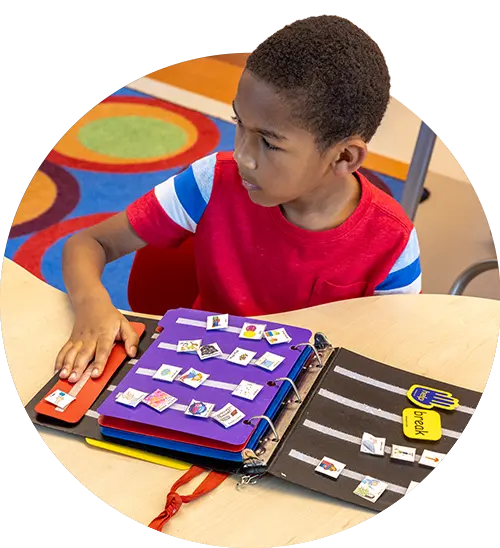
PECS is a picture-based communication system. The PECS user needs a way to store, access, and transport their pictures. There is flexibility in the creation of the materials used to teach PECS. Independent research supports that the type of the picture is not part of the protocol, and we recommend using what is most convenient for your team and appropriate for the learner. To ensure pictures are durable, laminate is often used to protect pictures. However, other options are available, such as packing tape, sheet protectors, etc., and many of the materials can be “home-made.” We love seeing the creative ways families and professionals prepare materials as they teach their learner to communicate with PECS.
The Pyramid Approach to Education® (PAE), developed by Dr. Andy Bondy, provides educators and families with specifics on the Why’s, What’s, and How’s of teaching. His approach emphasizes the importance of asking, “how do I help someone learn?” It gives a framework to create effective learning environments, so that every person can experience active engagement in meaningful and functional activities. The PAE is a science-based approach, which helps educational teams and families best support individuals to develop skills that open doors to a rich, happy, and fulfilling life for the learner. The PAE blends a functional approach to behavior analysis while emphasizing the importance of functional communication and generalization. Pyramid Consultants worldwide have various credentials, including behavior analysts, speech pathologists, psychologists, certified teachers, and many others. Our team is passionate, and we pride ourselves on consistently engaging in ongoing conversations with learners, their families, and educational teams to prioritize which skills are most valuable to teach.
As with typically developing children, we incorporate vocabulary as it becomes meaningful for our learners. Initial vocabulary is “fringe” vocabulary so the learner can communicate about specific items and activities. As “core” words become meaningful, we add those pictures to our learners PECS book.
PECS can help expand communication skills for all individuals, including learners who may be considered Gestalt Language Processors (GLPs).
The body of research supporting the effectiveness of PECS as an evidence-based practice is substantial and continues to expand, with more than 240 research articles from all over the world. Research is current and in 2023 alone over 20 articles about PECS were published.
Pyramid uses cookies on our website to give you the most relevant experience by remembering your preferences and repeat visits. Some cookies are necessary to help our website work properly and can't be switched off, and some are optional but help Pyramid learn user habits to better improve customer experiences.
For instance, we and third party services such as Google Analytics use information about your devices and your online interactions with us to provide, analyze and improve our services.
By selecting "Manage Cookies," you can learn about and disable specific cookie and data tracking.
You can learn more by reviewing our Privacy Policy and manage your cookie setting options at any time by clicking on "Manage Cookies" at the bottom of any page.
Do you accept cookies on our website?
By accepting cookies, you will accept and enable ALL cookies and data tracking. To manage what cookies to enable or disable, and to learn what data we track, click on Manage Cookies.
Read More »
| Cookie | Duration | Description |
|---|---|---|
| _GRECAPTCHA | 6 months | Google Recaptcha service sets this cookie to identify bots to protect the website against malicious spam attacks. |
| cookielawinfo-checkbox-advertisement | 1 year | Set by the GDPR Cookie Consent plugin, this cookie is used to record the user consent for the cookies in the "Advertisement" category . |
| cookielawinfo-checkbox-analytics | 11 months | This cookie is set by GDPR Cookie Consent plugin. The cookie is used to store the user consent for the cookies in the category "Analytics". |
| cookielawinfo-checkbox-functional | 11 months | The cookie is set by GDPR cookie consent to record the user consent for the cookies in the category "Functional". |
| cookielawinfo-checkbox-necessary | 11 months | This cookie is set by GDPR Cookie Consent plugin. The cookies is used to store the user consent for the cookies in the category "Necessary". |
| cookielawinfo-checkbox-others | 11 months | This cookie is set by GDPR Cookie Consent plugin. The cookie is used to store the user consent for the cookies in the category "Other. |
| cookielawinfo-checkbox-performance | 11 months | This cookie is set by GDPR Cookie Consent plugin. The cookie is used to store the user consent for the cookies in the category "Performance". |
| CookieLawInfoConsent | 1 year | Records the default button state of the corresponding category & the status of CCPA. It works only in coordination with the primary cookie. |
| PHPSESSID | session | This cookie is native to PHP applications. The cookie is used to store and identify a users' unique session ID for the purpose of managing user session on the website. The cookie is a session cookies and is deleted when all the browser windows are closed. |
| viewed_cookie_policy | 11 months | The cookie is set by the GDPR Cookie Consent plugin and is used to store whether or not user has consented to the use of cookies. It does not store any personal data. |
| wp_woocommerce_session_* | 2 days | WooCommerce sets this cookie to make a unique code for each customer so that it knows where to find the cart data in the database for each one. |
| Cookie | Duration | Description |
|---|---|---|
| _hjSession_2319872 | 30 minutes | This cookie is set by HotJar to provide functions across pages for its data analytics. |
| Elegant_Themes_Promo_State | 7 days | This cookie is set by us to store the status of a type of notice banner, and whether it has currently been set to dismissed or not by the user. |
| FacebookOptOut | 100 years | Set by Facebook for WooCommerce, this cookie tracks whether certain settings have been opted out while syncing the site's WooCommerce shop with Facebook's services. |
| woocommerce_recently_viewed | session | This cookie is set by WooCommerce to store performed actions on the website. |
| Cookie | Duration | Description |
|---|---|---|
| __utma | 2 years | This cookie is set by Google Analytics and is used to distinguish users and sessions. The cookie is created when the JavaScript library executes and there are no existing __utma cookies. The cookie is updated every time data is sent to Google Analytics. |
| __utmb | 30 minutes | Google Analytics sets this cookie, to determine new sessions/visits. __utmb cookie is created when the JavaScript library executes and there are no existing __utma cookies. It is updated every time data is sent to Google Analytics. |
| __utmc | session | The cookie is set by Google Analytics and is deleted when the user closes the browser. It is used to enable interoperability with urchin.js, which is an older version of Google Analytics and is used in conjunction with the __utmb cookie to determine new sessions/visits. |
| __utmt | 10 minutes | Google Analytics sets this cookie to inhibit request rate. |
| __utmv | 2 years | The __utmv cookie is set on the user's device, to enable Google Analytics to classify the visitor. |
| __utmz | 6 months | Google Analytics sets this cookie to store the traffic source or campaign by which the visitor reached the site. |
| Cookie | Duration | Description |
|---|---|---|
| _ga | 2 years | The _ga cookie, installed by Google Analytics, calculates visitor, session and campaign data and also keeps track of site usage for the site's analytics report. The cookie stores information anonymously and assigns a randomly generated number to recognize unique visitors. |
| _ga_* | 1 year 1 month 4 days | Google Analytics sets this cookie to store and count page views. |
| _ga_G4XDDSLLJZ | 2 years | This cookie is installed by Google Analytics. |
| _gcl_au | 3 months | Provided by Google Tag Manager to experiment advertisement efficiency of websites using their services. |
| _hjAbsoluteSessionInProgress | 30 minutes | Hotjar sets this cookie to detect the first pageview session of a user. This is a True/False flag set by the cookie. |
| _hjFirstSeen | 30 minutes | Hotjar sets this cookie to identify a new user’s first session. It stores a true/false value, indicating whether it was the first time Hotjar saw this user. |
| _hjIncludedInPageviewSample | 2 minutes | Hotjar sets this cookie to know whether a user is included in the data sampling defined by the site's pageview limit. |
| _hjIncludedInSessionSample | 2 minutes | Hotjar sets this cookie to know whether a user is included in the data sampling defined by the site's daily session limit. |
| _hjSession_* | 1 hour | Hotjar sets this cookie to ensure data from subsequent visits to the same site is attributed to the same user ID, which persists in the Hotjar User ID, which is unique to that site. |
| _hjSessionUser_* | 1 year | Hotjar sets this cookie to ensure data from subsequent visits to the same site is attributed to the same user ID, which persists in the Hotjar User ID, which is unique to that site. |
| _hjSessionUser_2319872 | 1 year | Hotjar sets this cookie to store a unique user ID for its data sampling. |
| CONSENT | 2 years | YouTube sets this cookie via embedded youtube-videos and registers anonymous statistical data. |
| Cookie | Duration | Description |
|---|---|---|
| _fbp | 3 months | This cookie is set by Facebook to display advertisements when either on Facebook or on a digital platform powered by Facebook advertising, after visiting the website. |
| fr | 3 months | Facebook sets this cookie to show relevant advertisements to users by tracking user behaviour across the web, on sites that have Facebook pixel or Facebook social plugin. |
| IDE | 1 year 24 days | Google DoubleClick IDE cookies are used to store information about how the user uses the website to present them with relevant ads and according to the user profile. |
| test_cookie | 15 minutes | The test_cookie is set by doubleclick.net and is used to determine if the user's browser supports cookies. |
| VISITOR_INFO1_LIVE | 5 months 27 days | A cookie set by YouTube to measure bandwidth that determines whether the user gets the new or old player interface. |
| YSC | session | YSC cookie is set by Youtube and is used to track the views of embedded videos on Youtube pages. |
| yt-remote-connected-devices | never | YouTube sets this cookie to store the video preferences of the user using embedded YouTube video. |
| yt-remote-device-id | never | YouTube sets this cookie to store the video preferences of the user using embedded YouTube video. |
| yt.innertube::nextId | never | YouTube sets this cookie to register a unique ID to store data on what videos from YouTube the user has seen. |
| yt.innertube::requests | never | YouTube sets this cookie to register a unique ID to store data on what videos from YouTube the user has seen. |
| Cookie | Duration | Description |
|---|---|---|
| VISITOR_PRIVACY_METADATA | 6 months | This cookie is set by YouTube to store the user's cookie consent state for the current domain. |